
The National Advanced Air Mobility Center of Excellence (NAAMCE) is a hub for aviation innovation in Ohio, fostering collaboration among government, higher education, and private sector entities engaged in research and development of new technologies, from uncrewed aircraft to electric vertical take-off and landing vehicles (eVTOLs).
OARnet has supplied critical infrastructure for this work, first extending its statewide fiber-optic backbone to the Springfield-Beckley Municipal Airport in 2014 and later expanding those connections to support the launch of NAAMCE at the site in 2023. NAAMCE, funded by the U.S. Department of Defense, JobsOhio, and the city of Springfield, provides new shared research space and supports job creation in the advanced air mobility industry.
In the last few years, higher education institutions and private sector entities have benefited from the connectivity and collaborative environment provided by NAAMCE and OARnet. Colleges and universities are advancing critical aviation research while providing new hands-on educational opportunities for students, in partnership with industry leaders on site.
Kent State integrates cybersecurity with engineering design
Kent State University has been gaining national attention for its cybersecurity engineering program, which was ranked a top U.S. degree offering in 2025. The National Security Agency (NSA) has designated the university as a National Center of Academic Excellence in Cyber Defense, and the Ohio Cyber Range Institute has named it a Regional Programming Center. The university also is launching a new graduate certificate program and exploring the development of a graduate degree in cybersecurity.
After 20 years of teaching and research in networking and cybersecurity at the University of Houston, Professor Deniz Gurkan came to Kent State in 2023 to lead its computer engineering technology and cybersecurity engineering programs in the College of Aeronautics and Engineering. One aspect of Kent State’s program that attracted Gurkan to Ohio is also a key strength of its educational curriculum: Cybersecurity is fully integrated into engineering system design rather than viewed as an additional element to incorporate.
“Students see this integration in front of their eyes – it’s relevant to the world they will be in when they are managing cybersecurity of a critical infrastructure,” Gurkan said.
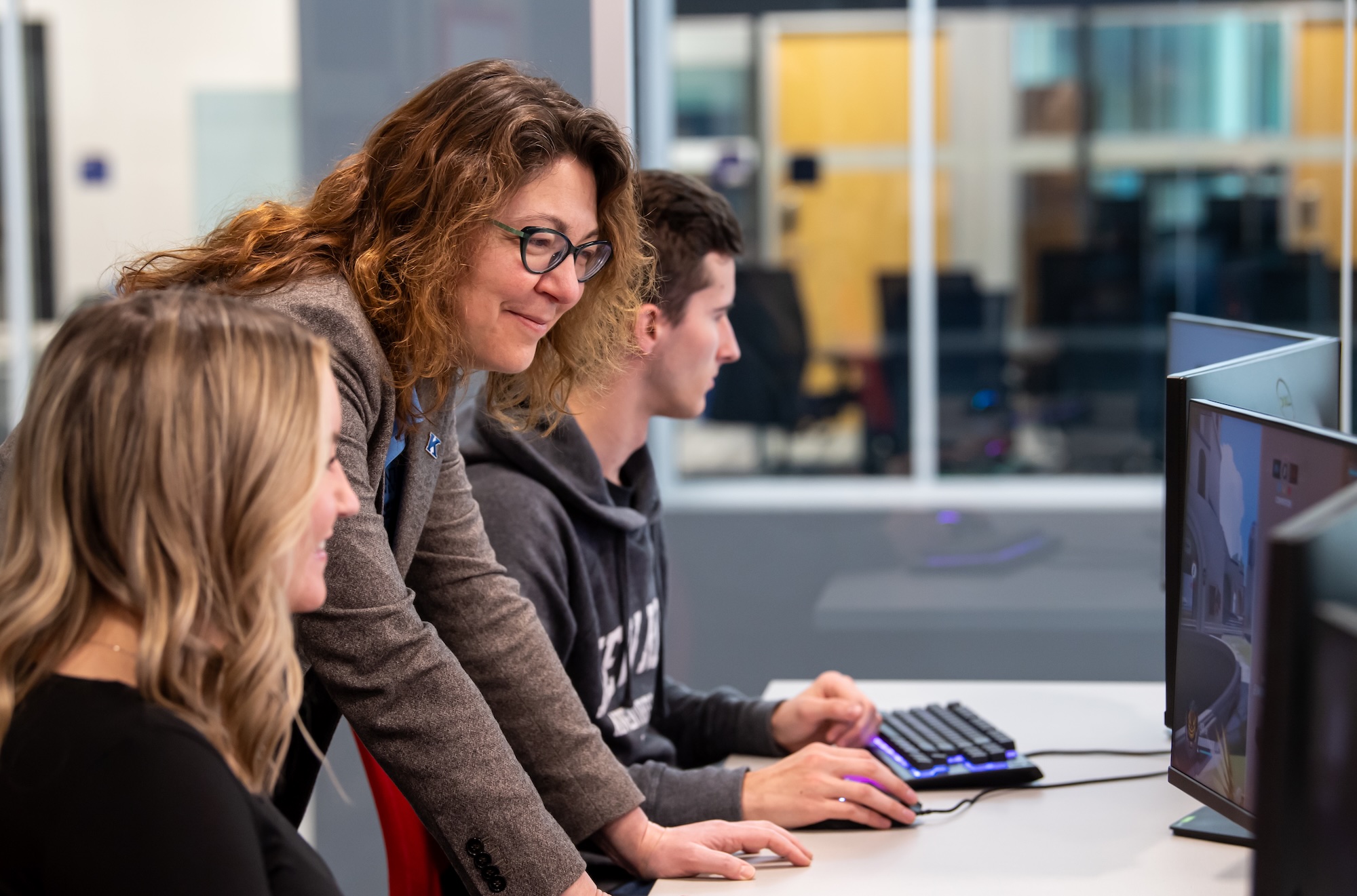
Professor Deniz Gurkan works with students in the College of Aeronautics and Engineering at Kent State University. Gurkan leads research exploring how cybersecurity can strengthen the resilience of emerging aviation and advanced air mobility systems. Photo Credit: Kent State University
Kent State’s program also focuses on teaching students how to conduct risk assessments and write and design cybersecurity policy controls for engineering systems.
“Our graduates will be able to map an engineering system to these risk categories and design a posture that is customized to that system’s requirements, implement it, and then manage the risk moving forward,” Gurkan said.
During her time in Texas, Gurkan was prominently involved in building test beds for networking research, as well as network applications and modeling. She worked with OARnet Executive Director Pankaj Shah, who at the time was leading the Lonestar Education and Research Network (LEARN).
Now in Ohio, Gurkan has been impressed with the statewide leadership and culture of coordination of networking resources and research. Through a National Science Foundation (NSF) project, she met Eric Adams, founder and lead engineer for AAMTEX (Advanced Air Mobility of Texas) at NAAMCE, who also has extensive test bed research experience. They are exploring how they can address cybersecurity in the advanced air mobility space to create a trustworthy system with risk mitigations and resilience for traffic management of simultaneously present uncrewed and crewed vehicles, accommodating every region’s data needs within the networking infrastructure.
During a member meeting in 2025, OARnet invited Adams to speak to Ohio higher education institutions about how he has leveraged the OARnet network and its Internet2 connections to provide fast and reliable data transmission for the operation of drones and eVTOLs. With support from the Ohio Supercomputer Center, AAMTEX has been able to deliver data to researchers within and beyond Ohio for real-time and offline analysis, including Kent State’s cybersecurity research.
“We want to make this available to as many universities in Ohio as we can,” Adams said.
Gurkan, Adams, and other entities interested in these issues have since had discussions at NAAMCE about how to capitalize on synergies within the research and networking community to help Ohio advance new technologies in the air mobility space.
“With OARnet’s support on the infrastructure side, this is a great initiative for researchers and educators to access real-life data and systems security scenarios in the state of Ohio and the nation, especially through connections with the test beds such as the NSF’s FABRIC,” Gurkan said.
Sinclair College advances technology and workforce development
Sinclair College’s National Unmanned Aerial Systems (UAS) Training and Certification Center is at the forefront of aviation technology innovation, a member of the Federal Aviation Administration (FAA) Alliance for System Safety of UAS through Research Excellence (ASSURE) UAS Center of Excellence and affiliate member of the National Science Foundation (NSF) Center for Autonomous Air Mobility and Sensing (CAAMS) Industry-University Cooperative Research Center (IUCRC). In addition to workforce training and outreach, the center is engaged in applied research and technology development, including modeling and simulation, data analytics and processing, and prototyping for various businesses and startup companies.
“From an R&D perspective, our sweet spot is taking existing technology, whether it be a prototype or commercial-off-the-shelf, and integrating new components and applying them in use cases to explore the value proposition or areas of needed improvement for adoption or utility,” said Andrew Shepherd, chief research officer at Sinclair College.
Sinclair has long seen OARnet as a key resource for this work and has advocated for stronger networking connections to the Springfield-Beckley Municipal Airport and research institutions that support national testing of new technologies. In April 2019, Sinclair was able to conduct the first Beyond-Visual-Line-of-Sight (BVLOS) flight of a UAS leveraging SkyVision, a tool enabling such operations to occur in the National Airspace System, created by the Air Force Research Laboratory and the Ohio Department of Transportation. These BVLOS tests demonstrate how UAS and AAM aircraft can safely operate in locations where an on-the-ground operator cannot view their flight path.
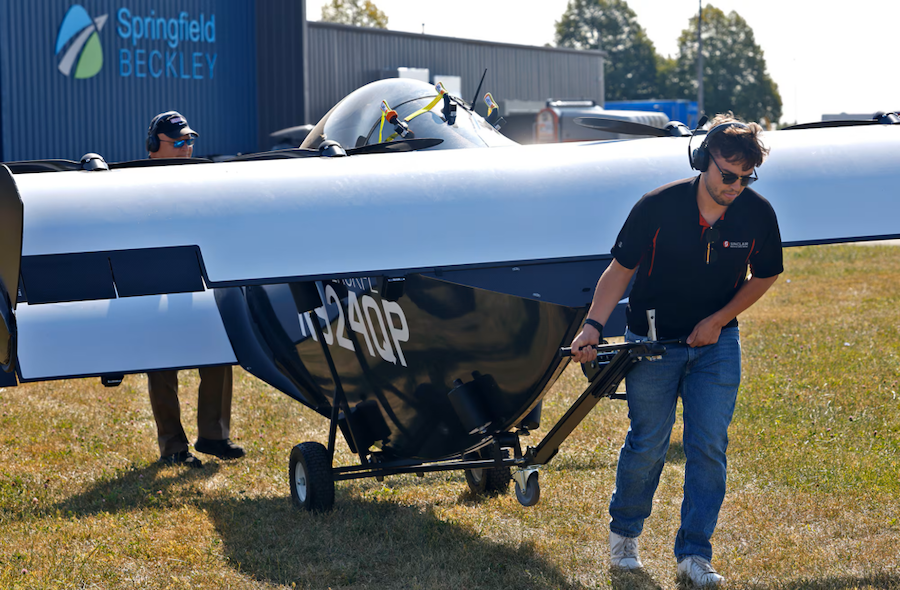
NAAMCE has expanded Sinclair’s presence at the airport, which now features a 20-person classroom, workstations, and hangar space for the college’s aircraft, which includes an eVTOL and flight simulators. The new facility allows Sinclair to conduct work for small businesses and the federal government.
“That’s an example of leveraging the facility, the connectivity to the site, and our presence there to advance nationally important flight-testing research,” Shepherd said.
Workforce development—from K-16 to continuing education for industry professionals—is also at the heart of Sinclair’s efforts. Sinclair has hosted curriculum development workshops on topics such as simulation, data analytics, cybersecurity, manufacturing, and robotics for industry and higher education institutions around the state. At the NAAMCE facility, Sinclair can showcase how aviation professionals apply those skills to real-time research applications with new technologies, supported by a network of public and private collaborators, said Alison Norton, director for digital transformation initiatives in the Sinclair College National UAS Training and Certification Center.
“We demonstrate how critical these skills are to advancing digital engineering, manufacturing, and aviation capabilities,” Norton said. “This provides us with the very first opportunity throughout the nation—not just in Ohio—to create pipelines for internships and apprenticeships.”
Shepherd and Norton foresee growth in such opportunities in Ohio in the coming years, as companies announce plans for new manufacturing facilities and industry professionals seek information about how to incorporate artificial intelligence into curricula and research initiatives. As the AAM industry expands, secure, high-speed connections will be even more important, Shepherd said.
“Some states have infrastructure similar to OARnet, but we certainly don’t take it for granted,” Shepherd said. “If anything, we need to keep challenging ourselves to be creative to leverage it and use it as a differentiator for research and training.”
Written by Andrea Gibson
Since 1987, OARnet has delivered technology-based solutions that reduce costs, increase productivity and improve customer service. As a division of the Ohio Department of Higher Education's Ohio Technology Consortium, OARnet serves Ohio's education, health care, public broadcasting and government communities. Other members of the consortium include the Ohio Supercomputer Center and OhioLINK.
